The security analytics mesh — and why your SIEM might be the bottleneck
Vega's federated model points to where SecOps is heading: less data movement, more intelligence at the edge.
Traditional SIEM models force organizations to centralize massive volumes of data — increasing cost, complexity, and operational friction. Most security teams know this. Fewer have a clear picture of what comes next.
The centralization tax
Every byte you ship to a centralized SIEM costs you twice: once to move it, once to store it. And the bill compounds — log volumes grow faster than budgets. The result is a familiar pattern: security teams start filtering out data sources to control cost, which means the very visibility SIEM was supposed to provide starts shrinking. You end up paying more to see less.
Vega's Security Analytics Mesh — the architecture
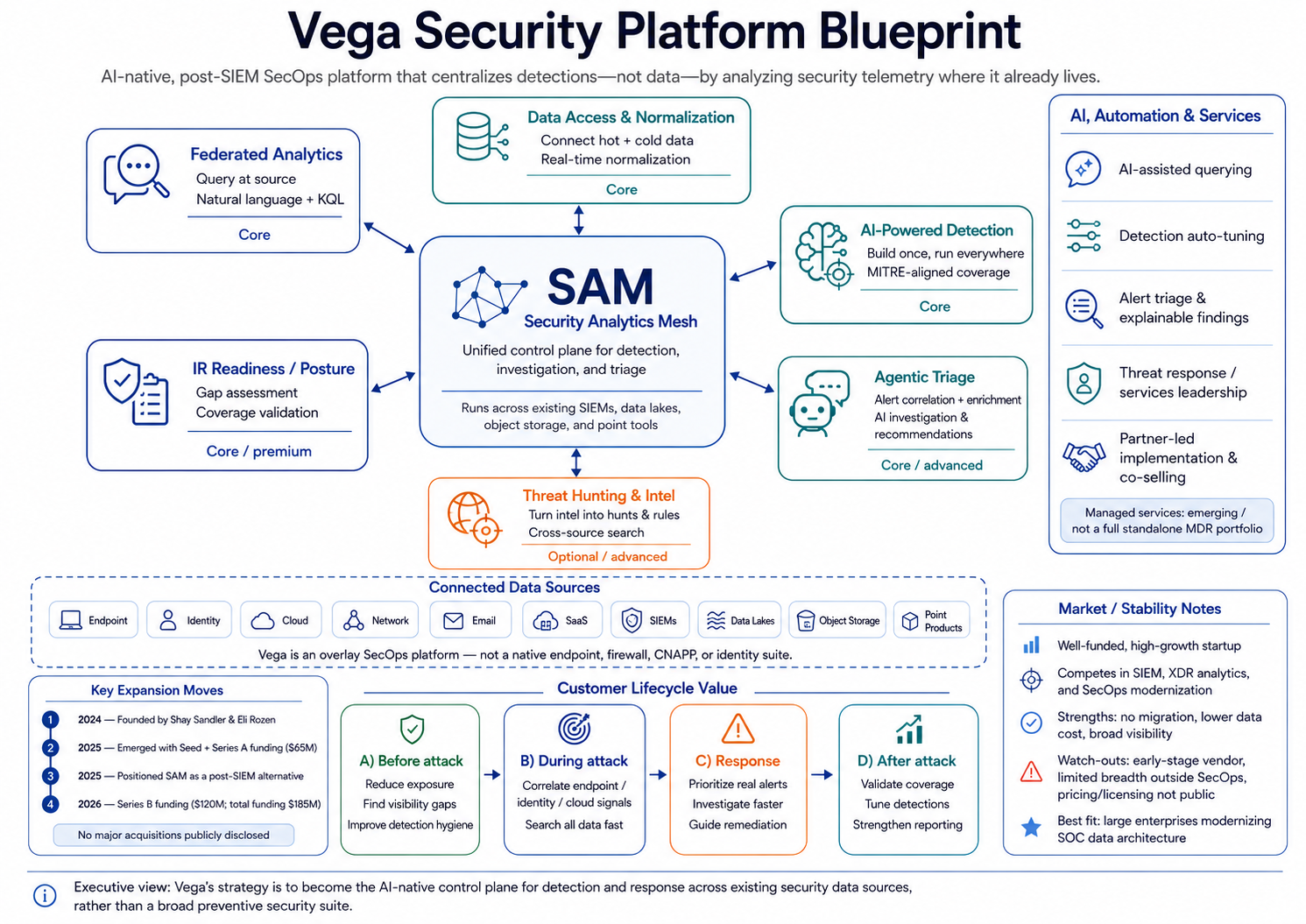
Vega's SAM (Security Analytics Mesh) takes a fundamentally different approach. Instead of pulling all telemetry into a single warehouse, it pushes analytics to where the data already resides. At the center sits a unified control plane for detection, investigation, and triage that runs across existing SIEMs, data lakes, object storage, and point tools.
The platform connects to endpoint, identity, cloud, network, email, SaaS, and data lake sources without requiring migration. Around the core are five capability modules: federated analytics (query at source, natural language + KQL), AI-powered detection (build once, run everywhere, MITRE-aligned), agentic triage (alert correlation + enrichment + AI investigation), threat hunting and intel (cross-source search, turn intel into rules), and IR readiness and posture validation.
The practical upside is immediate: broader visibility without the ingestion bill. Security teams get access to data they had previously excluded for cost reasons, and investigation timelines compress because the data is already indexed where it sits.
AI-native detection and agentic triage
Where Vega gets interesting for SOC operators is the AI layer. Detection auto-tuning assisted by machine learning — not the marketing version of AI, but the practical kind: models that learn your environment's baseline and surface anomalies that hand-written rules miss. Detections are built once and deployed everywhere, with MITRE ATT&CK alignment out of the box.
The agentic triage layer goes further. Instead of an analyst manually pivoting across five tools to investigate an alert, agentic workflows handle the initial correlation, enrichment, and context-gathering. The analyst still makes the call — but they start from a briefing with explainable findings, not a blank screen.
Market context and honest caveats
Vega is a well-funded, high-growth startup — founded in 2024 by Shay Sandler and Eli Rozen, with $185M in total funding through a 2026 Series B. They are positioning SAM as a post-SIEM alternative, competing in the SIEM, XDR analytics, and SecOps modernization space.
Strengths: no data migration required, lower data cost, broad visibility across existing tools. Watch-outs: early-stage vendor, limited breadth outside SecOps, pricing and licensing not public, managed services still emerging (not a full standalone MDR portfolio). Best fit: large enterprises modernizing their SOC data architecture who want an overlay rather than a rip-and-replace.
What this means for the SOC stack
Vega is not trying to be another endpoint platform, firewall, or CNAPP. It is positioning itself as an AI-native control plane for detection, investigation, and response across existing tools and data repositories — and the customer lifecycle reflects this: reduce exposure before attack, correlate signals during attack, prioritize and investigate faster during response, and validate coverage after attack.
The industry has spent a decade consolidating tools into platforms. The next phase looks different: orchestration layers that sit above your existing stack and make the whole thing smarter without requiring you to rip and replace.
For enterprise security teams evaluating their next move, the pattern is clear: less data movement, more intelligence, faster outcomes. Whether Vega specifically is the right fit depends on your stack — but the architectural direction is worth studying regardless.