Okta's blueprint — identity as the control plane, not the whole stack
Okta is not trying to be your endpoint, SIEM, CNAPP, or SASE vendor. It is betting that identity becomes the connective tissue across all of them. Here is the portfolio, the overlaps, and the honest caveats.
Okta gets filed under "the login company" by people who last looked at it five years ago. That framing is now wrong in a way that matters. Okta has spent the last half-decade turning single sign-on into an identity security control plane — governance, privileged access, identity threat detection, posture management, and now identity for AI agents. For anyone building a security stack, the useful question is not "is Okta good at SSO." It is: where does identity stop being a convenience and start being the policy brain for the whole enterprise?
Why you should read this
Most vendor write-ups either sell you the platform or dismiss it. Neither helps when you are deciding what to standardize on. This is the practical version: what Okta actually is, where it is genuinely strong, where it is just an integration pretending to be a product domain, and where the licensing and overlap will bite you.
If you run security architecture: this is the map of what Okta covers natively versus what it expects your other tools to do. If you are an exec evaluating a platform bet: this is the strategy and the risk in plain terms. If you already own Okta: this is the overlap and migration guidance — Auth0 versus Okta Customer Identity, Advanced Server Access versus Privileged Access, Governance versus Lifecycle Management — that your renewal conversation will turn on.
What Okta actually is
Okta is an identity-first security platform. It did not start in endpoint, firewall, SIEM, cloud security, or networking. It started as cloud identity and access management for the workforce — SSO, directory, provisioning, MFA, lifecycle automation — and it has expanded from "connect employees to apps" into an identity security fabric that covers employees, contractors, partners, customers, privileged users, non-human identities, and AI agents.
The core control plane is identity: authenticate the user or workload, authorize access, govern entitlements, assess posture, detect identity risk, and automate response. What Okta is not: a native EDR, CNAPP, SIEM, DLP, firewall, or SASE mega-suite. It integrates with all of those and increasingly competes in adjacent identity markets — IGA, PAM, ITDR, CIAM, and AI identity security. Read everything below through that lens. Okta is the front door and the policy brain, not the building.
The evolution journey
Okta was founded in 2009 by Todd McKinnon and Frederic Kerrest, both former Salesforce employees, to solve cloud IAM as enterprises moved from on-prem apps to SaaS. The early center of gravity was workforce IAM: SSO, directory, app integrations, MFA, provisioning.
The first expansion was from access into lifecycle and governance — Universal Directory, Lifecycle Management, Adaptive MFA, API Access Management. The second was into customer identity, anchored by the Auth0 acquisition (announced 2021, closed May 3, 2021, roughly $6.5B in stock). The third — and the one most people have not absorbed — was the shift from identity administration to identity security: Identity Threat Protection, Identity Security Posture Management, Okta AI, and Privileged Access, with Spera (2024) deepening identity threat detection and posture, and Axiom Security (2025) modernizing privileged access.
The current platform shift is identity for every entity: humans, service accounts, workloads, non-human identities, and AI agents. Okta's 2026 messaging now frames the company around securing AI, machine, and human identity as a single control plane for the "agentic enterprise." That is the bet — that the next phase of security is identity-led because the number of identities is exploding.
The platform, layer by layer
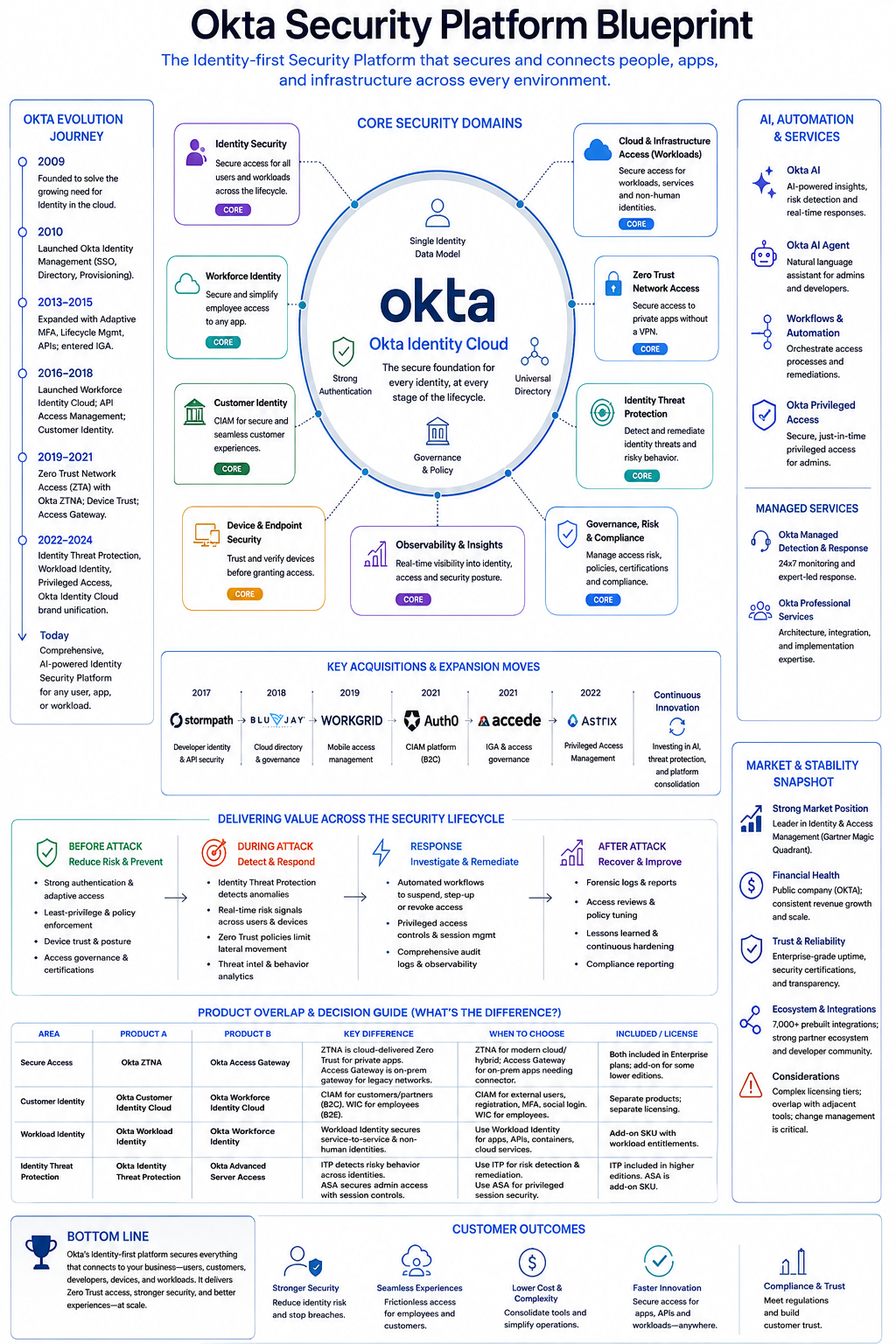
Workforce Identity is the foundation — SSO, Adaptive MFA, Universal Directory, Lifecycle Management, Device Access, API Access Management, Secure Partner Access, Access Gateway. It solves fragmented access across SaaS, cloud, legacy apps, directories, and devices. It is the core platform, sold in per-user suites and as individual products.
Customer identity comes in two motions: Auth0 (developer-first CIAM for custom apps, APIs, and digital products) and Okta Customer Identity (the Okta-branded CIAM direction for enterprises standardizing on Okta). Licensed separately from workforce IAM.
Identity Governance and Lifecycle Management handle joiner/mover/leaver workflows, access requests, certifications, and entitlement reviews — typically an add-on or higher-suite capability. Privileged Access (Okta's PAM) covers server access, service accounts, secrets vaulting, password rotation, approvals, and session recording. Identity Threat Protection plus Identity Security Posture Management push Okta into ITDR — detecting identity attacks and finding risky configurations and privilege sprawl. Device controls are identity-context, not EDR: Device Assurance, FastPass, phishing-resistant auth, device-trust policy. AI identity — Okta for AI Agents, Auth0 for AI Agents, and a Cross App Access protocol — is the newest and fastest-moving area.
Where Okta stops and your other tools start
This is the part that prevents bad architecture decisions. For several domains, Okta's contribution is identity context, not a native product — and treating it as a replacement is how you end up with a coverage gap.
Network / ZTNA / SASE: Okta offers Access Gateway and identity-aware app access, especially for private and legacy apps. It is not a full SASE stack like Zscaler, Netskope, or Palo Alto. Cloud security / CNAPP: Okta does not replace Wiz, Prisma Cloud, Orca, or Defender for Cloud. It contributes SSO, MFA, lifecycle, PAM, service-account governance, and workload identity. SIEM / XDR: Okta is not a SIEM. It produces high-fidelity identity telemetry — system logs, risk signals, threat detections — that feed Splunk, Sentinel, Google SecOps, CrowdStrike, or Cortex. Endpoint / DLP: not native. Okta is the policy and context layer those tools enforce against.
The one-line rule: if a domain is about packets, files, hosts, or workloads, Okta integrates. If it is about who, what they can access, and whether that access should exist, Okta owns it.
The product overlap and decision guide
Okta's biggest usability problem is its own catalog. Four overlaps cause the most confusion.
Workforce Identity vs Okta Customer Identity vs Auth0: Workforce for employees, contractors, and internal apps. Auth0 when developers are building customer-facing apps and need SDKs, APIs, branding, and extensibility. Okta Customer Identity when the buyer wants Okta-branded CIAM aligned with a broader enterprise identity strategy.
Identity Governance vs Lifecycle Management: Lifecycle Management executes provisioning and deprovisioning. Governance decides and certifies whether access should exist at all — requests, approvals, certifications. Mature enterprises need both.
Privileged Access vs Advanced Server Access: use Privileged Access going forward. This one has a hard deadline — Okta has stated Advanced Server Access will no longer be sold or renewed effective May 1, 2026, and existing customers must migrate to Okta Privileged Access within one year of their next renewal. If you are still on ASA, that migration is a project, not a checkbox.
Identity Threat Protection vs Identity Security Posture Management: ISPM is the "before attack" layer — finds weak configs, excessive privilege, stale accounts. ITP is the "during attack" layer — detects and responds to active identity risk. The buying mistake everyone makes is anchoring on product names instead of identity use cases. Anchor on the use case.
Value across the security lifecycle
Before attack — reduce exposure: SSO standardization, MFA/FastPass, device assurance, lifecycle deprovisioning, access reviews, least privilege, identity posture checks, and PAM. The strongest pre-attack value is hygiene — fewer unmanaged accounts, fewer weak auth paths, fewer stale privileges.
During attack — detect and correlate: impossible travel, suspicious login patterns, session risk, risky devices, privilege escalation, governance exceptions. Okta's job here is to detect identity-centric attacks and orchestrate response across the identity plane and connected tools.
Response — contain and remediate: suspend users, revoke sessions, force step-up MFA, reset credentials, change group membership, remove app access, trigger workflows. Privileged Access limits standing privilege and provides session records for investigation.
After attack — harden and report: audit logs, access reviews, governance campaigns, policy tuning, entitlement cleanup, and compliance evidence for SOX, HIPAA, PCI, and FedRAMP-style controls.
Market position, momentum, and the trust question
Okta has real momentum. In its most recent quarter (Q1 FY2027) it reported $765M revenue (up 11% YoY), $750M subscription revenue, remaining performance obligations of $4.719B, and $271M free cash flow — and it credited new-portfolio traction, especially Identity Governance, as validation of the unified-platform strategy. It also cited a strong showing in the 2026 Forrester Wave for Workforce Identity Security Platforms.
The position is strongest where customers want a neutral identity provider — independent from Microsoft, Google, AWS, or a broader security suite — in multicloud, multi-app, SaaS-heavy environments. That neutrality is the differentiation.
Trust is the honest caveat, and it should not be soft-pedaled. Okta disclosed a 2023 support case management incident in which a threat actor accessed files associated with 134 customers, including HAR files containing session tokens, and five customer sessions were hijacked. Okta's own root-cause writeup acknowledged investigation gaps, including failing to identify certain file downloads in support-vendor logs for 14 days. For an identity vendor — the company holding the keys — incident history is not a footnote. It belongs in the diligence file alongside the financials.
The bottom line
Okta is best understood as a neutral identity security control plane. Its strongest domains are workforce identity, customer identity, MFA, lifecycle, governance, privileged access, identity posture, and identity threat response. Its weak or non-native domains are endpoint, SIEM, CNAPP, SASE, DLP, and full MDR — those are integrations, not products.
The value is highest when identity is treated as the front door and policy brain for the enterprise: every user, device, app, workload, privileged account, and AI agent authenticated, authorized, governed, monitored, and remediated through one identity fabric. The strategic bet — that security becomes identity-led as AI agents and non-human identities multiply — is a good one. The risks to manage are equally concrete: licensing clarity, product overlap, the ASA-to-PAM migration path, and trust diligence. Buy Okta for what it is — the identity layer — not for what its catalog occasionally implies.